Building Your Own Home TV Channel: From Analog Coax to Digital Virtual Channels
admin / August 14, 2026
Ever since the release of the VCR, consumers have had the ability to run their own mini “broadcast stations” at home. Early VCRs and DVD players came equipped with built-in RF modulators that outputted signal on standard analog channels—usually Channel 3 or 4.
If you hooked up a coaxial cable from your VCR to multiple TVs in your house, any set tuned to Channel 3 could watch your tape. Because VCRs featured auxiliary audio and video inputs (RCA jacks), you weren’t limited to playing tapes—you could plug in a video camera, a video game console, or a media player and control 100% of the programming across your home network.
The Closed-Loop Advantage & The Over-the-Air Craze
These closed-circuit coaxial setups were completely legal because no signal was broadcast over the airwaves. The signal stayed isolated inside your home’s coax wiring, preventing interference with neighbors or commercial broadcasters.
However, some hobbyists wanted to go wireless.
For years, a popular company called Ramsey Electronics sold mail-order electronic kits. They offered low-power AM, FM, and TV transmitter kit—such as the famous Ramsey TV6—that allowed consumers to solder together their own micro-broadcaster. Under FCC Part 15 rules, unlicensed low-power devices can operate over the air provided they do not exceed strict power output limits or cause harmful interference to licensed stations.
Because these Part 15 TV transmitters operated under extreme power constraints, their range was tiny—often just a few feet for clear video. Interestingly, the audio portion (which used FM modulation) often traveled much further than the video signal! Eventually, as analog tuners disappeared from modern TVs and regulatory pressure increased, companies like Ramsey phased out these transmitter kits altogether.
The Digital Transition: Physical vs. Virtual Channels
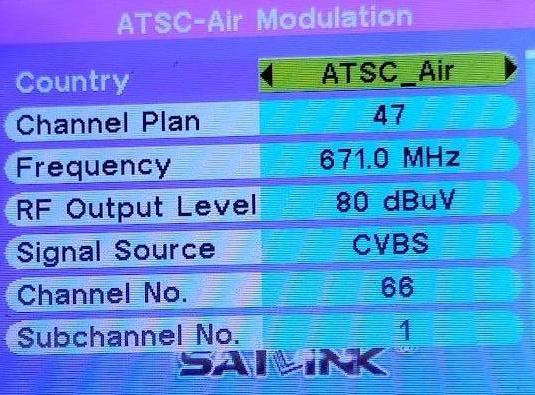
When the United States mandated the digital TV transition in 2009, the mechanics of television broadcasting fundamentally changed.
In the analog era, a station’s channel number directly matched its broadcast frequency. For example, a local station branded as “WQYU Channel 47” actually transmitted on physical RF Channel 47.
Digital television introduced Virtual Channels through a system called PSIP (Program and System Information Protocol):
- The Physical Channel: The actual frequency over the airwaves where the digital signal travels (e.g., RF Channel 47).
- The Virtual Channel: The number displayed on your TV set (e.g., 66.1).
This allowed stations to keep their recognizable legacy branding (Channel 47) even if their physical transmitter was moved to a different frequency. Furthermore, digital broadcasting introduced multicasting:
- 66.1 (Main Channel): High-definition network programming (CBS, NBC, ABC, FOX), local news, and primary shows.
- 66.2, 66.3, etc. (Subchannels): Standard-definition subchannels carrying retro TV networks (like MeTV or Antenna TV), CourtTV, weather radar, or shopping networks.
When you run a channel scan on a modern TV, the tuner maps these digital streams automatically.
The Modern Solution: Digital Modulators at Home
Today, you don’t need a legacy analog VCR to run a home broadcast system. Modern consumer devices known as Digital Modulators (or QAM / ATSC Modulators) allow you to inject high-definition HDMI sources directly into your home’s coaxial network.
With a digital modulator, you can assign your home video feed to an actual digital virtual channel (like 10.1). When you plug your TVs into the coax wall jacks and run a channel scan, your home video feed shows up right alongside digital cable or over-the-air feeds in crisp 1080p resolution.
Managing Signal Strength & Interference
While closed coax setups don’t broadcast over the air, adding a modulator to your home setup requires careful installation:
- Cable & Satellite Interference: Injecting a strong RF signal into a line that carries active cable or satellite TV can disrupt those services or cause channel overlap.
- Equipment Interference: Placing a modulator too close to networking hardware like routers or modems can cause RF leakage and noise.
- Signal Overload: Consumer modulators often push out an extremely powerful signal. If the signal is over-saturating your TV tuner or causing interference, extending the coaxial wire length (or using an inline attenuator) helps reduce output wattage and clean up the signal before it reaches your equipment.
Is This “Pirate TV”?
This should not be confused with illegal IPTV services—which stream copyrighted content over the internet—or traditional “pirate TV,” which involves transmitting over the airwaves on an unlicensed frequency above FCC Part 15 power limits.
As long as your digital modulator feeds strictly through a closed coaxial cable system inside your home, it poses no risk of over-the-air interference, stays fully compliant with regulations, and gives you complete control over your very own home television channel.